Eduqas · GCSE · English Language
Critical reading and comprehension
Master the essential skills of critical reading and effective writing for GCSE English Language. Learn how to analyse language and structure, evaluate texts, compare viewpoints, and produce compelling creative and transactional writing.
- 6 min read
- 3 worked examples
- 5 practice questions
- 8 key terms
Study Notes
Overview
GCSE English Language is fundamentally a skills-based qualification. Unlike Literature, where you study set texts, Language requires you to apply reading and writing skills to unseen texts from the 19th, 20th, and 21st centuries. Your goal is to demonstrate that you can understand explicit and implicit meanings (AO1), analyse how writers use language and structure for effect (AO2), compare different viewpoints (AO3), and critically evaluate texts (AO4). Furthermore, you must prove you can communicate effectively and imaginatively (AO5) with high technical accuracy (AO6).
Reading Skills
Identifying Information & Ideas (AO1)
The foundation of comprehension is the ability to locate and interpret information. Examiners look for your ability to identify both explicit information (what is directly stated) and implicit information (what is suggested or implied). When reading an unseen text, candidates should read actively — highlighting key details that address the question's focus.
Analysing Language (AO2)
When asked "how does the writer use language," candidates must go beyond mere feature-spotting. Identifying a simile earns no marks on its own; marks are awarded for explaining the effect of that simile on the reader.
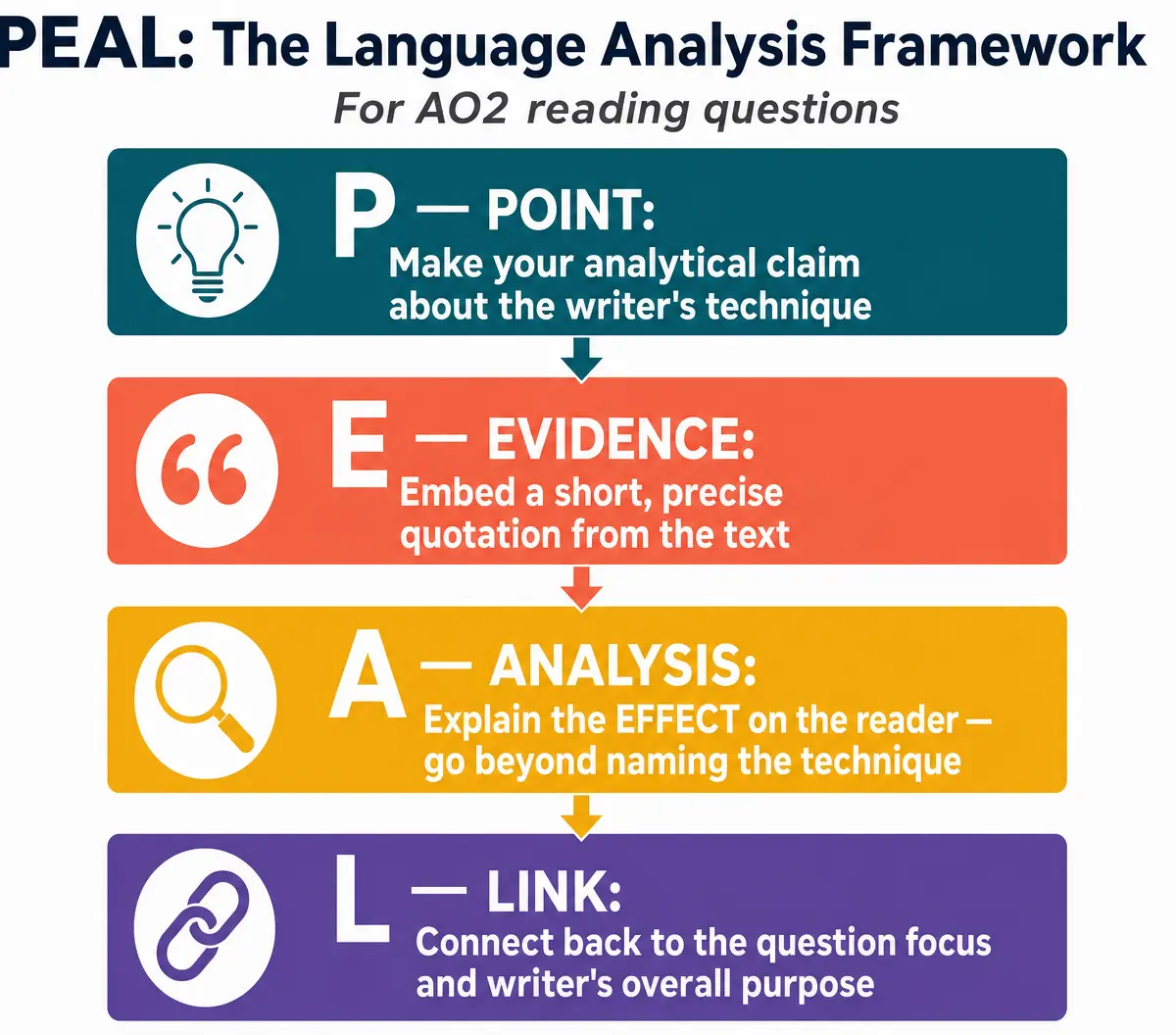
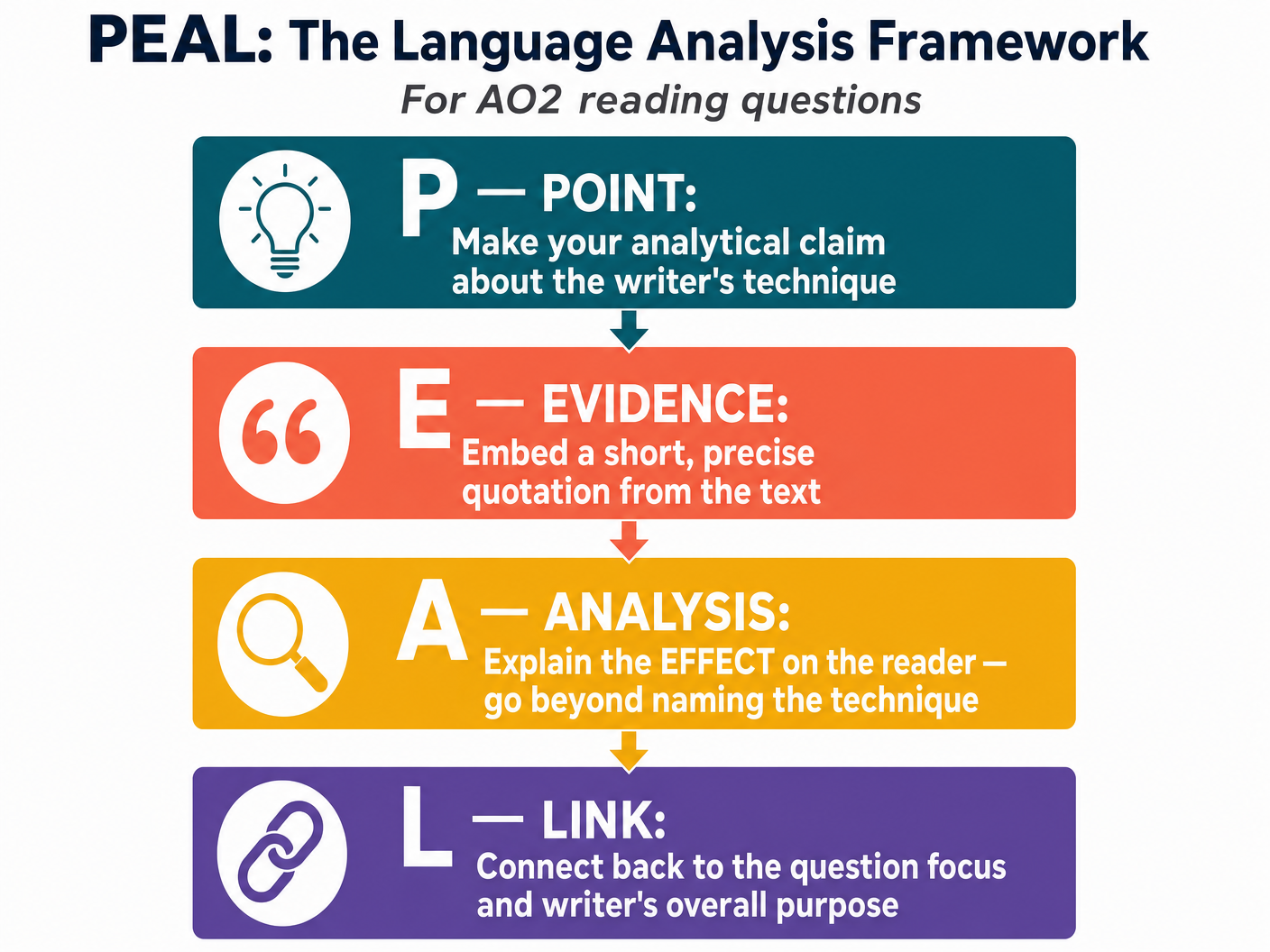
To achieve high marks, use the PEAL framework (Point, Evidence, Analysis, Link). Your analysis must explore the connotations of specific words and the imagery they evoke.
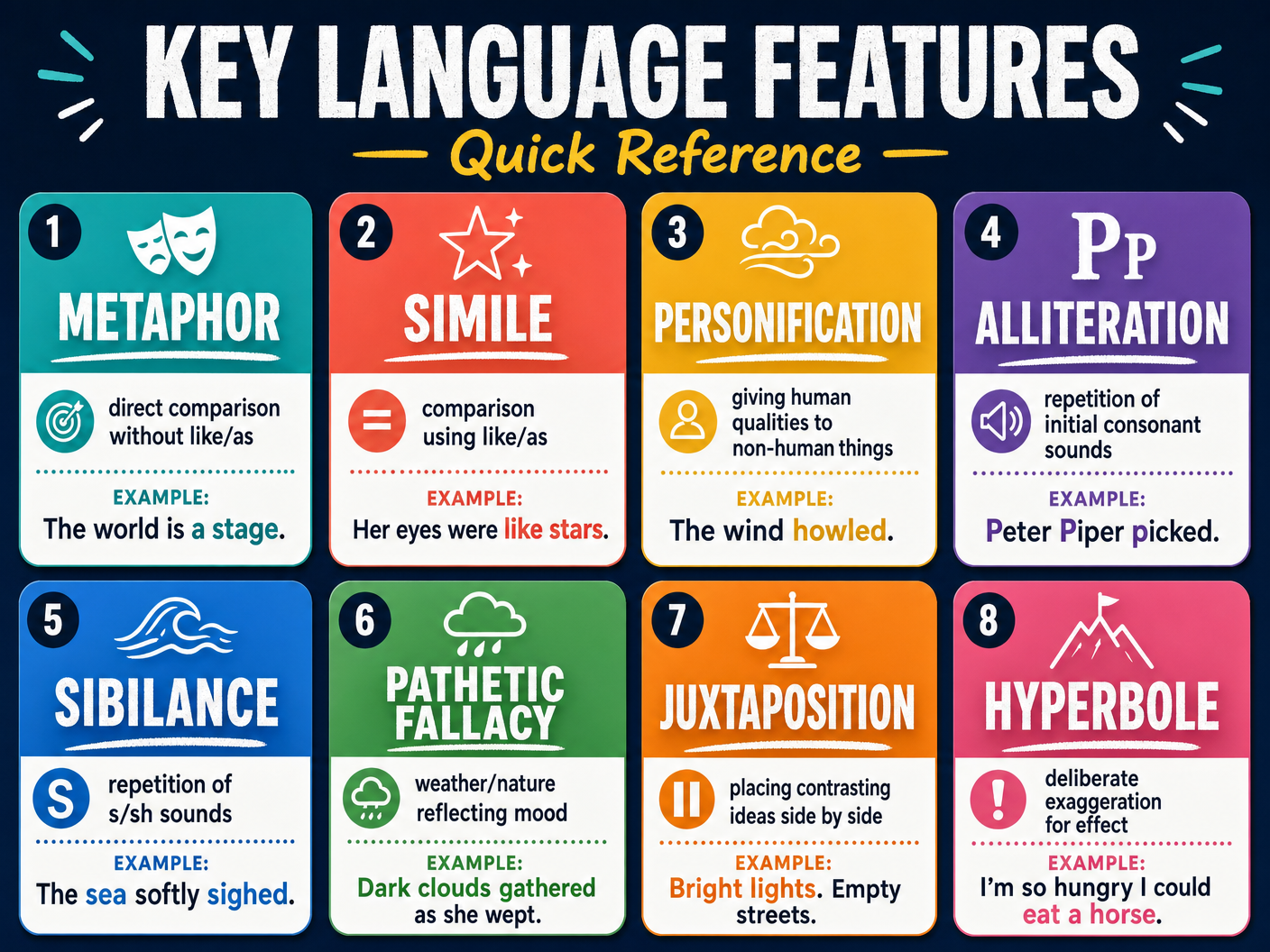
Key Language Features to Identify
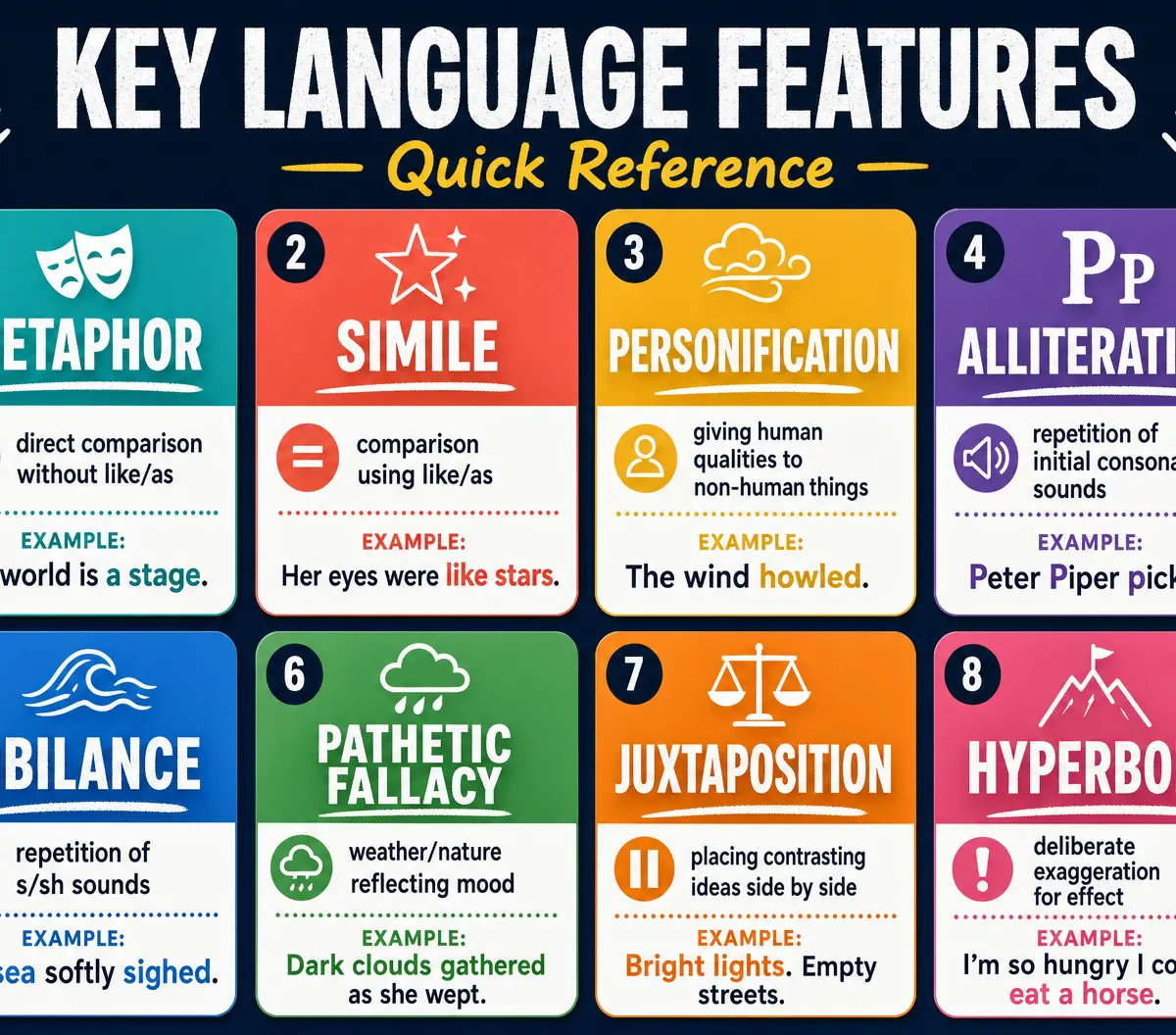
| Feature | Definition | Effect on Reader | Example |
|---|---|---|---|
| Metaphor | Direct comparison without using 'like' or 'as' | Creates vivid, often surprising imagery by merging two concepts | "The city is a concrete jungle." |
| Simile | Comparison using 'like' or 'as' | Helps the reader visualise something unfamiliar by comparing it to something familiar | "The wind howled like a wounded animal." |
| Personification | Giving human qualities to non-human things | Brings inanimate objects to life, often creating a specific atmosphere | "The shadows danced on the wall." |
| Pathetic Fallacy | Weather or environment reflecting mood | Establishes tone and foreshadows events | "Dark clouds gathered as she wept." |
| Alliteration | Repetition of initial consonant sounds | Draws attention to a phrase, can create pace or rhythm | "The cruel, cold wind." |
| Sibilance | Repetition of 's' or 'sh' sounds | Often creates a soft, hissing, or sinister atmosphere | "The sea softly sighed." |
| Juxtaposition | Placing contrasting ideas side by side | Highlights differences, creates tension or irony | "A beacon of hope in a sea of despair." |
| Hyperbole | Deliberate exaggeration for effect | Emphasises a point or heightens emotion | "I've told you a million times." |
Analysing Structure (AO2)
Structure questions require you to examine how a text is put together. Think of the text as a journey: where does the writer start, where do they take you, and where do you end up?
Key structural features include:
- Openings: How is the reader hooked? Is it in media res (in the middle of the action)?
- Shifts in focus: Does the narrative perspective change? Does the focus move from the external environment to internal thoughts?
- Sentence length variation: Short sentences build tension and pace; long, complex sentences can reflect overwhelming emotion or detailed description.
- Paragraph structure: A single-sentence paragraph forces the reader to pause and emphasizes a key point.
- Cyclical structure: Ending where the text began, suggesting inevitability or lack of escape.
Evaluating Critically (AO4)
Evaluation requires you to form a critical opinion about a text, supported by evidence. Questions often present a statement (e.g., "A student said this text is terrifying") and ask "To what extent do you agree?"
Candidates must weigh the evidence. A strong response acknowledges nuance: "To a significant extent, the writer creates terror through... However, the ending offers a moment of relief..." Always justify your opinion by analysing the writer's methods.
Comparing Writers' Viewpoints (AO3)
When comparing texts, examiners reward candidates who synthesize their points rather than writing about each text separately. You must compare:
- What the writers think or feel (their viewpoints).
- How they express it (their methods).
- How effectively they achieve their aims.
Use comparative connectives ("In contrast," "Similarly," "Whereas") to ensure your response is genuinely comparative.
Writing Skills
Creative Writing (AO5 & AO6)
Creative tasks (narrative or descriptive) demand imagination and control.
- Show, Don't Tell: Instead of saying "He was angry," describe his clenched fists and flushed face.
- Sensory Description: Engage sight, sound, smell, touch, and taste to build a vivid world.
- The One-Scene Rule: For a 45-minute task, do not try to write an epic novel. Focus on a single scene, a short time frame, and one or two characters.
- Structure: Plan a clear trajectory — a hook opening, a developed middle building to a climax, and a satisfying resolution.
Transactional/Non-Fiction Writing (AO5 & AO6)
Transactional writing (letters, articles, speeches) must be tailored to a specific Purpose, Audience, and Form (PAF).
- Purpose: Are you arguing, persuading, advising, or informing?
- Audience: Is it formal (a headteacher) or informal (peers)? Adjust your register accordingly.
- Form: Ensure you use the correct conventions (e.g., a headline for an article, a salutation for a letter).
Use the AFOREST mnemonic to remember persuasive techniques.
Technical Accuracy (SPaG) (AO6)
Spelling, Punctuation, and Grammar (SPaG) account for a significant portion of writing marks.
- Ambitious Punctuation: Demonstrate control over semicolons (;), colons (:), dashes (—), and parenthetical commas.
- Sentence Variety: Deliberately mix simple, compound, and complex sentences for effect.
- Cohesion: Use discourse markers ("Furthermore," "Consequently," "Nevertheless") to link paragraphs smoothly.
Visual Resources
4 diagrams and illustrations
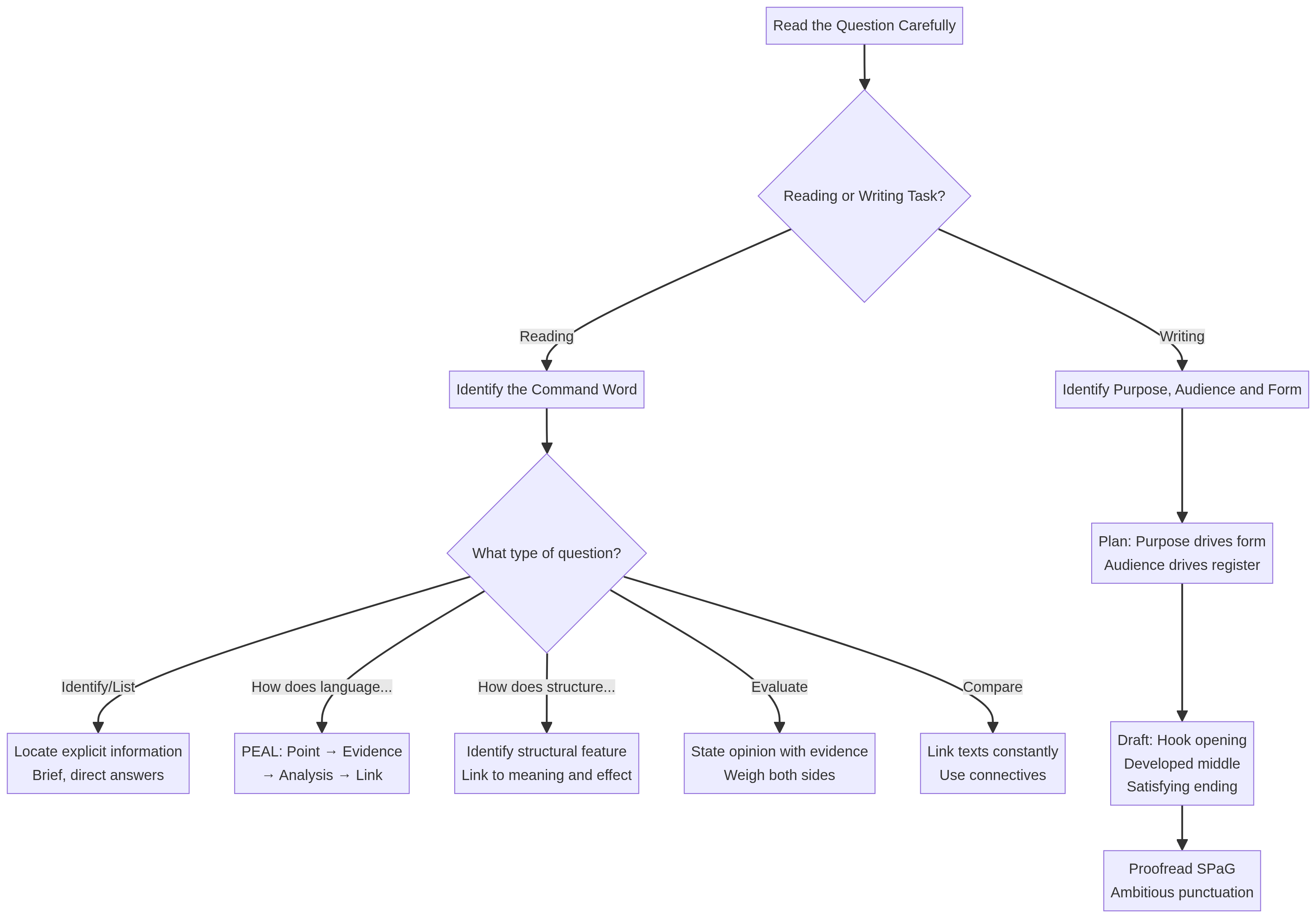
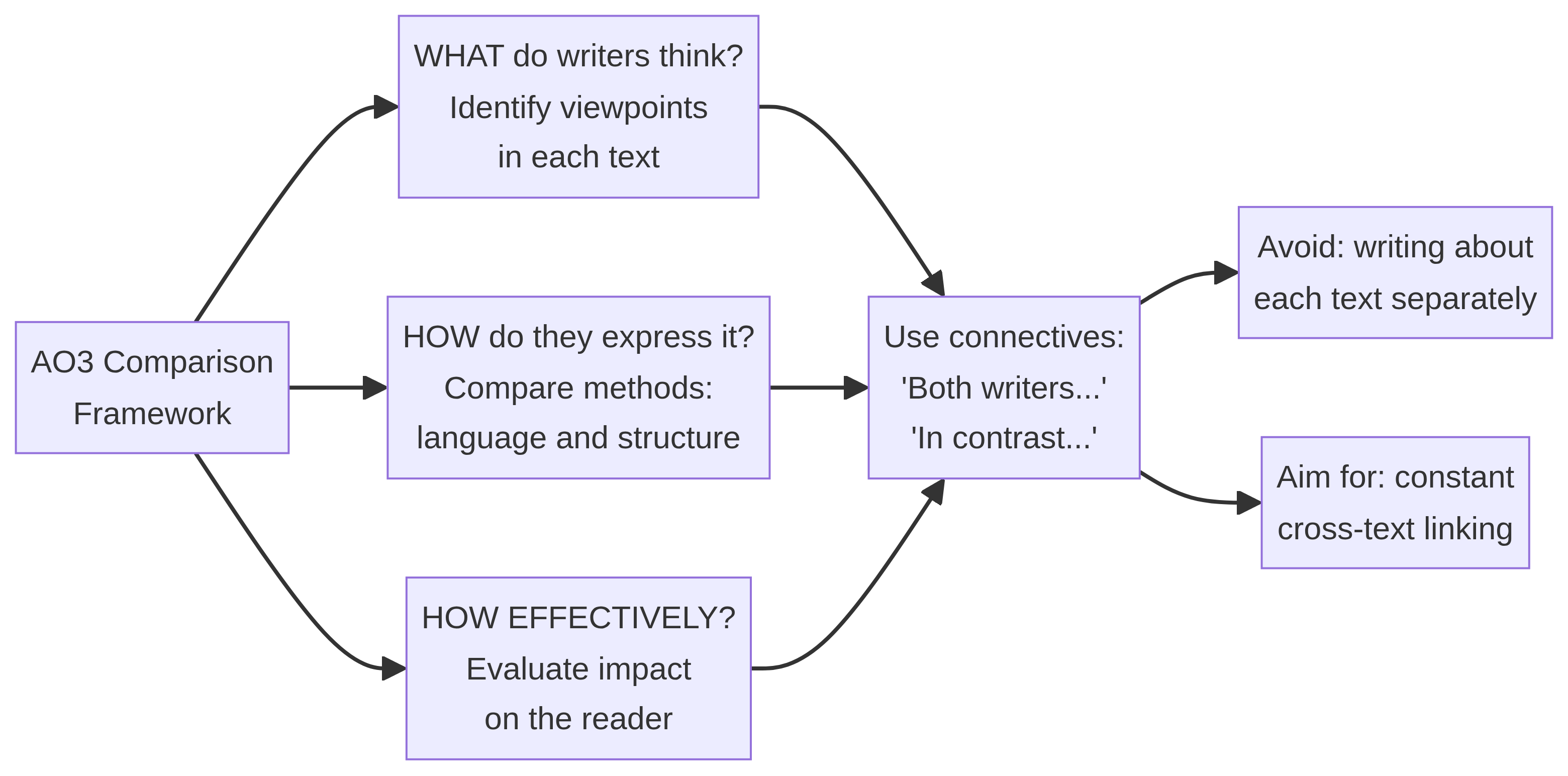
Interactive Diagrams
2 interactive diagrams to visualise key concepts
Conceptual Flow Outline
English Language exam approach flowchart
Conceptual Flow Outline
Comparison response framework
Worked Examples
3 worked examples — open one to explore the question and available guidance.
Practice Questions
Test your understanding — click to reveal model answers
Read lines 1-5. List four things you learn about the setting.
Hint: Look for explicit facts. You do not need to write long paragraphs.
How does the writer use language to create a sense of fear in the extract?
Hint: Use PEAL. Focus on specific word choices and their connotations.
How does the writer structure the text to interest the reader?
Hint: Look at the opening, shifts in focus, and sentence lengths.
'The writer effectively makes us hate the antagonist.' To what extent do you agree?
Hint: Evaluate the methods used. Weigh both sides if applicable.
Write a description suggested by this picture: [An image of a deserted, overgrown train station].
Hint: Focus on sensory details and atmosphere. Do not write an action-packed story.